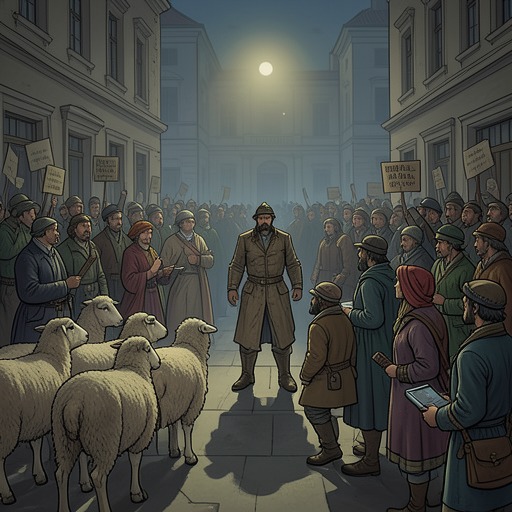
Humans are herd animals
Three Bags Full“Humans are herd animals” is Miss Maple’s decisive insight into the social world beyond the pasture: people, like sheep, form groups, gather around shared concerns, and can be separated from their community. The idea turns the flock’s own experience into a tool for interpreting the villagers—and makes George Glenn’s apparent isolation newly significant. It is an illuminating analogy, not a complete explanation: the sheep can observe human grouping, but they cannot reliably smell human emotion or know what a gathering means.
The analogy takes shape
Miss Maple connects the proposition to details the sheep have already observed. Humans live together in the village and come to see the spade together; their collective attention resembles the flock’s shared response to danger and disturbance. The thought gives the sheep a social pattern to look for where, until then, they had seen only separate human beings and puzzling actions.
The flock’s investigation begins in a scene that puts the comparison under pressure. George lies dead in the grass beside the hay barn, while the sheep meet near the cliff. After the first alarm, Miss Maple calms them and then examines the body, circling it, sniffing George and the spade, and finally putting her nose into the wound. Her inquiry depends on animal senses and collective discussion; understanding humans requires the same careful attention to what can actually be perceived.
The spade itself demonstrates both the usefulness and the limits of that method. When Mopple later finds it fallen in the meadow, he recognizes that its smell is unlike the usual scent of human tools: only a faint human trace remains. Following that trace leads him to a human moving through the mist. Objects and scents can connect people to events, but the evidence is partial, and a sheep’s interpretation must be built from what its senses can recover.
George outside the human flock
The analogy changes the way the sheep think about George. Sir Ritchfield exclaims that George left the flock; Miss Maple develops the thought, suggesting that he never belonged to the human herd, or may have been driven out of it. She points to his anger toward the village as something the sheep already know. In her theory, his death may be punishment for leaving the group—but this is the flock’s attempt to explain the murder, not a fact established by the evidence.
George’s position makes the comparison more than a general observation about people gathering. If humans are herd animals, then a human who stands apart may be vulnerable to exclusion or hostility, just as a sheep’s relation to its flock matters. The sheep’s horror at imagining their own shepherd separated from his community shows the emotional force of the idea. At the same time, the flock cannot know whether George was rejected, chose distance, or stood apart for some other reason.
Flocks, blindness, and human motives
Zora’s encounter with Gabriel’s sheep offers a sharp counterpoint. They graze shoulder to shoulder, yet at first they do not acknowledge her, even though she expects her scent to announce her arrival. Only when she bleats do their muzzles stop and their pale eyes turn toward her. Shared space and physical closeness do not automatically produce recognition. The scene complicates any easy equation between being grouped together and belonging to a community.
Miss Maple’s own encounter with human social life reveals another limit. Looking through a window at Beth and Rebecca, she can see and hear them but cannot smell them. Without scent, she cannot tell whether their expressions of feeling and fear are true; to her, the world behind the pane becomes incomplete and uncertain. The sheep’s model of humans is therefore shaped not only by what people do together, but by what sheep cannot perceive about them. Human social bonds are visible from the pasture, while their private meanings remain elusive.
A working principle, not a verdict
The idea lets the sheep translate an unfamiliar society into terms they understand, turning village gatherings into evidence of a human herd and George’s estrangement into a possible clue. Yet the analogy never settles the case by itself. The flock must keep watching, comparing traces, and revising explanations; even Miss Maple’s account of George’s place among the villagers remains conjecture.
The phrase also reverses the usual direction of judgment. The sheep do not simply appear as a herd to be managed by humans: they observe human communities as fellow social animals, with their own forms of attachment, exclusion, and collective action. The resulting insight is both an investigative tool and a reminder of its limits: resemblance makes human behavior legible, but it cannot erase the distance between the flock’s world and the people it is trying to understand.